Industrial Pump Repair Canada - Pump and Seal Repair and Replacement Services
ISO 9001 Certified
Industrial Pump Repair Canada - Pump and Seal Repair and Replacement Services
ISO 9001 Certified
Replacing a pump part rarely begins with a wrench. It begins with a careful question: what actually failed? A worn impeller, hardened gasket, scored shaft sleeve, or blocked seal can create similar symptoms. The wrong diagnosis may cause leakage, vibration, overheating, and another shutdown.
Dr. Heinz P. Bloch, a respected rotating-equipment reliability authority, offers a practical reminder: “Reliability begins with selecting the right component, not replacing it quickly.” That principle fits every pump parts replacement decision. Buyers should verify the pump model, serial number, dimensions, material grade, operating temperature, fluid compatibility, and expected pressure. A part that looks identical may use a different elastomer or wear-ring clearance. Small differences matter.
This guide, “7 Tips for Pump Parts Replacement Buyers,” focuses on choices that protect equipment and budgets. It considers supplier documentation, OEM and compatible alternatives, delivery timing, warranty terms, and lifecycle cost. A low purchase price can become expensive after repeated failures. Keep that in mind.
There is no perfect checklist. Even experienced teams can overlook corrosion under a seal face or misread an old nameplate. That is why measurements, photographs, maintenance records, and technical confirmation deserve attention. Ask clear questions before ordering. Confirm everything twice. Reliable pump parts replacement depends on evidence, not assumption, and this introduction prepares buyers to examine each decision with practical caution.
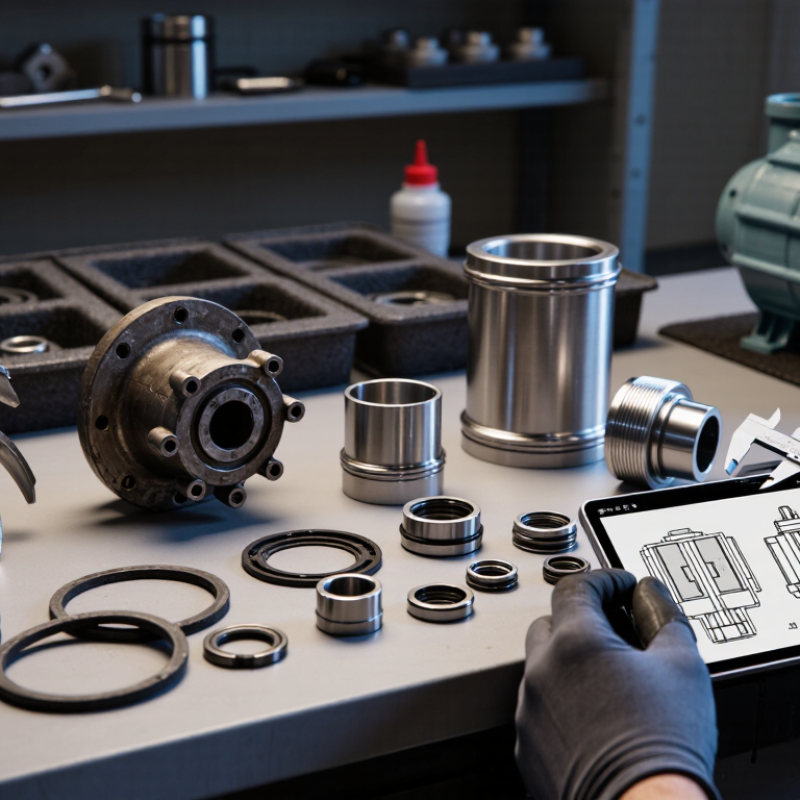
Before choosing replacement pump parts, define the pump’s real operating requirements. Record flow rate, total head, fluid temperature, viscosity, solids content, and operating hours. Do not rely only on the nameplate. Field conditions often differ from the original design.
Check seven details: flow, head, speed, pressure, temperature, materials, and duty cycle. Then compare them with the pump’s performance curve. A mismatch can cause vibration, overheating, seal damage, or unstable flow. The U.S. Department of Energy’s Improving Pumping System Performance sourcebook identifies pumping systems as major industrial energy users. Even small efficiency losses can become expensive during continuous operation. ISO 9906 also emphasizes verified hydraulic performance during pump acceptance testing.
Material selection needs practical judgment. Stainless steel may resist corrosion, but it is not automatically suitable for every chemical. Confirm compatibility for the casing, impeller, shaft sleeve, gasket, and elastomer. Ask for dimensional drawings and inspection records. A part that fits physically may still fail hydraulically. It happens.
Use actual site measurements, not assumptions. Check suction pressure with a calibrated gauge. Note unusual noise near the bearing housing. Review maintenance records for repeated seal failures. One overlooked detail, such as a thicker gasket, can change alignment. Replacement buyers should also verify tolerances, balancing requirements, and installation instructions. The weakest decision is often made when the old part is treated as the complete specification.
Check the nameplate, service records, and installation drawings. A similar-looking pump may use a different shaft length or impeller design. Record the model code, revision, serial range, and original operating conditions. Small details matter.
“Mechanical seal” or “wear ring” is too general for accurate purchasing. Compare the number with the latest service manual, parts list, or approved technical drawing. Then verify whether the number has been superseded. I have seen orders fail because one digit was copied incorrectly. It happens more often than expected.
Check dimensions, material grade, pressure rating, temperature range, rotation direction, connection size, and tolerance requirements. For seals, confirm face material and elastomer compatibility. For impellers, verify diameter, vane count, balance requirements, and keyway size. Ask the supplier for a dimensional drawing when information is incomplete. Measure the removed part carefully, but do not rely on worn dimensions alone. A damaged component can mislead even an experienced technician. Photograph the nameplate and the part beside a ruler. Keep these records with the purchase request.
Pump parts replacement buyers should compare materials, fit, and service life before comparing prices. A stainless-steel impeller may resist corrosion, while reinforced polymers can reduce weight and handle selected chemicals. Compatibility depends on temperature, pressure, pH, solids, and shaft speed. Check the fluid chart, not only the catalog title. Tip 1: Record the liquid, temperature, pressure, and particle size before ordering. A small mismatch can damage seals within weeks.
The U.S. Department of Energy reports that pumping systems may represent about 25% of industrial electricity use. Its Improving Pumping System Performance source also states that system improvements can often save 20–50% of pumping energy. These figures concern the complete system, not one replacement part. Still, they show why efficiency matters. Tip 2: Confirm the replacement curve, clearance, and motor load. A part that fits physically may operate inefficiently. That mistake is easy to make.
Expected service life should come from operating evidence, not optimistic marketing. Review inspection records, seal failures, vibration trends, and abrasive exposure. ISO 5199 provides technical requirements for centrifugal pump construction, but it does not promise a universal lifespan. Tip 3: Ask for material certificates, dimensional tolerances, test results, and a stated life basis. “Long-lasting” is too vague. In practice, service-life estimates remain imperfect because maintenance quality and fluid conditions change. A lower-cost component may look sensible, until downtime costs more than the original saving.
| Tip | Buying Decision | Recommended Material Options | Typical Application Compatibility | Typical Expected Service Life* | Key Buyer Check |
|---|---|---|---|---|---|
| 1 | Match the wetted material to the pumped liquid | 316 stainless steel for many clean or mildly corrosive liquids; polypropylene or PVDF for stronger chemical exposure; cast iron for non-corrosive water service. | Water, dilute chemicals, acids, alkalis, solvents, and abrasive slurries require different material selections. | 2–10 years | Confirm chemical concentration, temperature, fluid pH, solids content, and corrosion data before ordering. |
| 2 | Verify dimensional and hydraulic compatibility | Use parts manufactured to the original dimensional envelope or an approved equivalent specification. | Centrifugal, positive-displacement, submersible, process, and self-priming pumps each use different component geometries. | 3–8 years | Check shaft diameter, keyway, impeller diameter, casing clearances, bolt pattern, rotation, flow rate, and head requirements. |
| 3 | Select the correct seal and elastomer | EPDM for water and many aqueous chemicals; FKM for many oils and elevated temperatures; PTFE for broad chemical resistance; ceramic or silicon carbide faces for demanding seal duties. | Seal compatibility depends on fluid chemistry, temperature, pressure, shaft speed, and presence of suspended solids. | 6 months–5 years | Never substitute an elastomer solely by size; verify temperature limits, chemical resistance, face materials, and pressure rating. |
| 4 | Account for abrasion and suspended solids | Hardened stainless steel, high-chrome alloys, polyurethane, or abrasion-resistant rubber may outperform standard metals in slurry service. | Suitable for wastewater, mineral slurries, sand-bearing water, dredging fluids, and other solids-laden liquids when correctly specified. | 3 months–3 years | Record solids size, concentration, hardness, fluid velocity, and whether the particles are sharp or rounded. |
| 5 | Check temperature and pressure limits | Metallic components generally tolerate higher temperatures than many thermoplastics; PTFE-based sealing materials can provide broad temperature resistance when properly supported. | Hot water, thermal fluids, process chemicals, and high-pressure applications require verified component ratings. | 1–7 years | Compare maximum continuous temperature, pressure, thermal cycling, and pressure-shock conditions with the actual duty cycle. |
| 6 | Evaluate operating conditions that shorten component life | Use components designed for the actual speed, load, lubrication method, alignment, and suction conditions rather than selecting only by pump size. | All pump types can suffer premature wear from dry running, cavitation, misalignment, vibration, overload, or insufficient lubrication. | 3 months–10 years | Review NPSH conditions, start-stop frequency, shaft alignment, bearing loads, vibration levels, and maintenance history. |
| 7 | Compare total cost instead of purchase price alone | Consider upgraded alloys, replaceable wear components, balanced seals, and documented dimensional control where downtime is costly. | Higher-cost materials may be justified in continuous-duty, corrosive, abrasive, or difficult-to-access installations. | 1–10+ years | Compare part price, installation labor, energy impact, inspection intervals, spare-parts availability, and the cost of unplanned downtime. |
*Service-life figures are broad industry estimates under appropriate operating conditions and regular maintenance. Actual life varies with fluid chemistry, temperature, solids, pressure, speed, installation quality, and duty cycle.
7 Tips for Pump Parts Replacement Buyers
Verify Supplier Quality, Fit, Warranty, and Technical Support
When buying replacement pump parts, do not trust a model number alone. Ask the supplier for drawings, material details, inspection records, and batch traceability. A reliable supplier should explain how each part was tested. Look for clear tolerances, surface finishes, and pressure ratings. Vague answers deserve caution. I once accepted a cheaper impeller without checking its alloy specification. It corroded sooner than expected and delayed production.
Fit must be verified with measurements from the original part. Check shaft diameter, keyway size, bolt spacing, seal dimensions, and impeller clearance. Also confirm operating temperature, fluid type, flow rate, and pressure. A part can look identical yet fail during installation. Request a dimensional drawing before payment. If possible, compare the drawing with caliper readings taken by your maintenance team. Small errors matter.
Read the warranty carefully. Check its duration, coverage, return process, and exclusions for improper installation or unsuitable fluids. Ask who pays shipping when a defect is confirmed. Technical support is equally important. Can an engineer review photographs, installation steps, and vibration readings? Will someone help troubleshoot leakage or unusual noise? Get response times in writing. Support promises can sound excellent, but practical testing is wiser. Keep records of emails, measurements, and inspection results. This makes future purchasing more accurate, even when the first decision was not.
Replacement success starts before the new part arrives. Confirm the pump model, duty point, material, seal arrangement, and shaft dimensions. Check alignment and coupling condition before installation. Clean the casing and flush the pipework; small debris can damage a fresh seal quickly. Measure twice. The U.S. Department of Energy reports that pumping systems can represent about 27% of industrial electricity use, so incorrect installation can create a long-term energy penalty.
After fitting the part, rotate the shaft manually and verify lubrication requirements. Open valves gradually, remove trapped air, and watch pressure, flow, vibration, and motor current during the first run. Record these readings at normal operating conditions. Hydraulic Institute guidance emphasizes testing near the pump’s intended operating point, not merely confirming that liquid moves. A zero-leakage inspection after several hours is also wise. Do not guess.
Build preventive maintenance into the replacement plan. Set inspection intervals for seals, bearings, coupling alignment, strainers, and vibration trends. The U.S. Department of Energy’s Improving Pumping System Performance guide notes that system optimization can produce significant energy savings, often through control and maintenance improvements rather than new equipment. Keep one verified spare seal and the installation measurements on file. A perfect checklist still misses unusual noise or rising temperature. Review the plan after the first month, because actual service conditions often expose assumptions made during purchasing.