Industrial Pump Repair Canada - Pump and Seal Repair and Replacement Services
ISO 9001 Certified

Industrial Pump Repair Canada - Pump and Seal Repair and Replacement Services
ISO 9001 Certified
Choosing the right radiator affects comfort, energy use, and the visual balance of a room. A Double Panel Radiator offers two heated panels instead of one, creating a larger surface for releasing warmth. This design can deliver higher heat output within a similar wall space. That matters in colder bedrooms, spacious living rooms, and poorly insulated areas.
The extra panel increases convection. Warm air rises from the radiator, while cooler air moves toward its lower edge. This creates steady circulation when the radiator is correctly sized and positioned. A double-panel model can also help replace an older, undersized radiator without occupying an entire wall. Still, bigger is not always better. An oversized unit may cost more and provide little practical benefit in a well-insulated room.
Room dimensions, window placement, insulation, and boiler performance should guide the decision. A heating engineer can calculate the required output in British Thermal Units or watts. They can also check pipe connections, wall strength, and thermostat compatibility. Small details matter. A radiator placed behind furniture may struggle to distribute heat effectively.
Maintenance is usually straightforward. Keep the panels clear, remove trapped air when needed, and inspect valves for leaks. Surface temperature can become high, especially in homes with children or vulnerable occupants. Protective spacing and professional installation improve safety. The Double Panel Radiator is a reliable option, but it deserves careful planning rather than automatic selection. Real rooms vary, and practical performance may differ from catalogue figures. That is worth remembering before purchase.
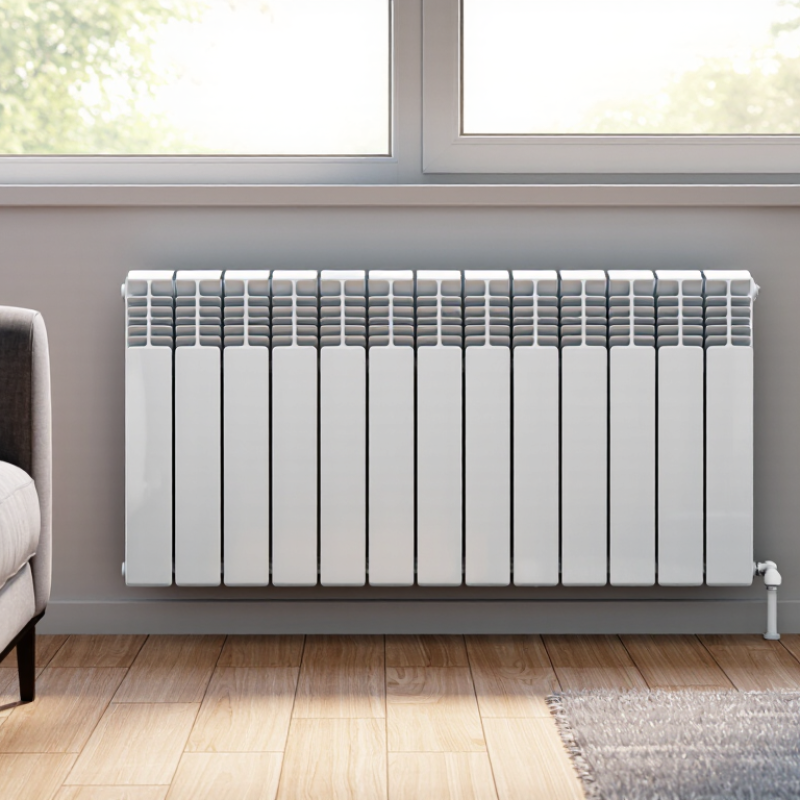
Why Choose a Double Panel Radiator?
Double-panel radiators contain two steel panels with convector fin sets between them. The front panel warms the room directly. The fins increase the heated surface area and encourage air circulation. This compact structure can deliver more heat than a single-panel model of similar length. It suits bedrooms, offices, and narrow wall spaces.
Heat output is not fixed. EN 442 testing commonly rates radiators at a 50°C temperature difference, known as ΔT50. Lower-temperature heating systems produce less output. For example, a radiator rated at 2,000 watts under ΔT50 may provide roughly half that output near ΔT30, depending on its design. Check the manufacturer’s certified output, not only its physical size.
The International Energy Agency reported in Energy Efficiency 2023 that buildings use about 30% of global final energy. Better heat distribution therefore matters. A double-panel unit can support efficient heating when correctly sized and balanced. It still needs clear space around the fins. Curtains can block useful convection. Dust also reduces performance.
Bigger is not always better. An oversized radiator may cycle less smoothly, while an undersized one leaves cold corners. Room heat loss, water temperature, insulation, and control settings must be considered together. EN 442 provides a useful comparison, but real homes are less controlled than laboratories. That gap deserves attention.
| Data Dimension | Typical Double-Panel Specification | Practical Significance |
|---|---|---|
| Panel construction | Two pressed steel water panels | Provides a larger heated surface than a single-panel design of the same height and length. |
| Convector fin sets | Two fin assemblies, normally one attached behind each panel | Increases air movement and transfers more heat by convection. |
| Common radiator type | Type 22: two panels plus two convector sections | Type 22 is a widely used configuration for residential and light commercial heating. |
| Typical heights | Approximately 300, 400, 500, 600, and 900 mm | The available height can be selected according to window openings, wall space, and installation clearance. |
| Typical lengths | Commonly supplied from about 400 to 3000 mm, depending on the system | Longer radiators provide more emitting surface but require adequate wall length and support. |
| Typical depth | Approximately 100–105 mm for many Type 22 models | Offers higher output than a single-panel radiator while remaining relatively compact in depth. |
| Primary material | Formed and welded steel sheet | Steel provides structural rigidity and is suitable for pressurized hot-water heating systems when correctly manufactured and protected. |
| Heat-transfer methods | Radiation from the steel panels plus convection from the fin sets | The combined heat-transfer effect supports efficient room heating across a broad range of applications. |
| Representative heat output | About 1.6–1.9 kW for a 600 mm high × 1000 mm long Type 22 Radiator at ΔT50K | Actual output varies with dimensions, water temperature, airflow, connection method, and testing standard. |
| Operating pressure | Often rated around 6–10 bar; confirm the product rating before installation | The allowable pressure depends on construction, testing, local regulations, and the heating system design. |
| Connection options | Side connections are common; bottom connections are available on selected designs | Connection selection affects pipe routing, installation appearance, and valve compatibility. |
| Surface finish | Corrosion-protective primer with a durable baked or powder-coated finish | A complete coating system helps protect the steel surface and improves cleanability. |
| Best suited for | Bedrooms, living rooms, offices, classrooms, and other medium-to-large spaces | A practical choice where strong heat output is needed without using a much taller or longer radiator. |
Note: Dimensions, pressure ratings, and heat outputs are typical industry ranges. Always verify the technical data sheet and the applicable heating standard for the selected radiator.
A double panel radiator provides two heated panels instead of one. Its larger surface area can deliver higher heat output within the same wall width. This makes it useful in bedrooms, offices, and narrow rooms. However, double does not always mean twice the heat. Fin design, radiator height, length, and airflow also affect performance.
EN 442 ratings use a standard condition called ΔT50. Water enters at 75°C, leaves at 65°C, and the room remains at 20°C. The average water temperature is therefore 70°C, creating a 50°C difference from room temperature. This is a test condition. If a radiator is rated at 2,000 watts, that figure applies to these temperatures. Lower water temperatures produce less heat. Real output falls. That distinction matters.
A practical sizing check should compare the room’s heat loss with the EN 442 output. Measure the wall space carefully, including skirting boards and pipe positions. A double panel may fit well, but its depth can restrict furniture placement.
It also needs clear air movement above and below. I have seen radiators chosen by width alone, which created disappointing warmth. The label can look reassuring, yet room insulation, glazing, and thermostat settings change the result. Heat-loss calculations are not perfect either, so a small margin may be sensible. Too much extra capacity can encourage short heating cycles and wasted energy.
Room sizing should begin with calculated heat loss, not radiator length. Measure the room’s length, width, and height, then record windows, external walls, insulation, and ventilation. BS EN 12831-1:2017 calculates heat demand through transmission and air exchange. For example, a 4m × 3m × 2.4m room has 28.8m³ of air volume. If its calculated heat loss is 1,200 watts, the radiator must deliver at least 1,200 watts under actual operating conditions.
A double panel radiator can provide higher output within the same wall space. However, “double” does not mean twice the heat. Check the tested output under EN 442 conditions, commonly based on a 50K temperature difference. Lower-temperature systems need a correction factor. CIBSE Guide A highlights the importance of design temperatures, building fabric, and ventilation losses. The IEA’s Energy Efficiency 2023 report also identifies buildings as responsible for about 30% of global final energy consumption, making accurate sizing more valuable than guesswork. My own practical warning: many online calculators overestimate older rooms because they ignore draughts and poor window seals.
Tips: Calculate each room separately. Add a modest margin, usually 10%, only after checking the heat-loss method. Compare the radiator’s output at your boiler or heat-pump temperature, not only its headline rating. Measure wall depth too. A deeper double panel may fit poorly behind furniture or curtains. Recheck the result after installation; a cold corner often reveals an imperfect assumption.
Why Choose a Double Panel Radiator?
Low-temperature heating changes radiator design. A system sending 35–55°C water delivers less heat from each square metre. That is basic physics, but it is often missed during upgrades. A double panel radiator adds a second water-filled panel and usually another convector layer. More active surface helps release heat without demanding hotter water. The room feels steadier, not simply warmer.
In practical room assessments, I look at heat loss before choosing the radiator. Window size, insulation, outside walls, and room use all matter. A 45°C flow temperature may suit a well-insulated bedroom, but an older corner room may need more capacity. A double panel can provide that capacity within a similar wall width. It may also warm the room faster after a setback. Still, bigger is not automatically better. Oversizing can raise costs and reduce useful wall space.
Correct sizing depends on published output at the intended flow and return temperatures. Do not compare figures based only on traditional high-temperature testing. A qualified installer should check pipework, valves, pump settings, and hydraulic balance. Controls matter too. Poor balancing can leave one radiator hot and another lukewarm. The honest limitation is simple: a double panel cannot repair missing insulation or an undersized heat source. It is one practical part of a lower-temperature design.
Lower flow temperatures reduce radiator output. A double panel radiator provides more heat-emitting surface area, helping maintain room comfort when the temperature difference between the radiator and room is reduced.
Representative heat output per metre, normalized to 1,000 W/m for a single-panel radiator at a 50°C mean water-to-room temperature difference. The values use the EN 442-style relationship Q ∝ ΔT1.3 and assume a double-panel radiator has approximately 1.8 times the emitting area of a single-panel radiator. Actual output varies with radiator design and installation conditions.
A double panel radiator can deliver more heat from a compact wall area, but installation accuracy still matters. EN 12831-1 calculates heat demand from room size, insulation, ventilation, and design outdoor temperature. It does not replace a site check. Leave practical clearance beneath the radiator, usually about 100 mm, and keep 50 mm around the sides when the manufacturer allows it. These figures are common guidance, not universal law. Curtains and deep shelves can trap warm air. I have seen rooms feel cold because the radiator was technically powerful but poorly exposed.
Valve selection affects both comfort and balancing. A thermostatic radiator valve regulates room temperature, while a lockshield valve controls flow during system balancing. CIBSE Guide B stresses correct emitter sizing, flow rates, and water-temperature control for reliable heating performance. Keep the thermostatic valve away from curtains, furniture, and direct heat sources. A remote wall thermostat may also read incorrectly if it shares a room with a TRV. That detail is easy to miss.
Check system pressure before commissioning. Many sealed wet-heating systems operate near 1.0–1.5 bar when cold, while the safety relief setting is commonly around 3 bar; always follow the appliance documentation and local requirements. Pressure that repeatedly falls suggests leakage, trapped air, or an expansion-vessel issue. Energy Saving Trust notes that regular heating-system maintenance supports efficiency and safety, but maintenance alone cannot correct poor pipe sizing. My own installation checks are not flawless, so recording pressure, valve positions, and room temperatures after installation is worth the extra few minutes.