Industrial Pump Repair Canada - Pump and Seal Repair and Replacement Services
ISO 9001 Certified

Industrial Pump Repair Canada - Pump and Seal Repair and Replacement Services
ISO 9001 Certified
Choosing the right Box Design Ex Motors requires more than comparing power ratings and catalog prices. These motors support equipment operating in areas where flammable gas, vapor, dust, or fibers may create serious ignition risks. Their enclosed construction, certified protection method, and controlled surface temperature help reduce those risks when correctly selected and installed. Yet, the best motor is not automatically the largest or most expensive option.
This guide examines how Box Design Ex Motors perform in pumps, fans, conveyors, compressors, and process machinery. It considers enclosure strength, cooling design, ingress protection, temperature class, efficiency, duty cycle, and maintenance access. A motor running beside a dusty grain conveyor faces different demands from one serving a chemical transfer pump. That difference matters. Certification markings must match the hazardous-area classification, equipment group, protection level, and operating environment. Always verify current requirements with qualified engineers and recognized certification records.
Real-world experience also reveals practical details that product sheets may hide. A heavy enclosure can improve durability, but it may complicate lifting and replacement. Efficient cooling can reduce heat buildup, although blocked airflow may quickly change performance. Seals, bearings, cable glands, and terminal boxes deserve equal attention. Small installation mistakes can undermine otherwise reliable equipment. This discussion may not identify one universal winner. Conditions vary, and some recommendations require closer review. Still, the comparison can provide a clearer path toward safer, more dependable motor selection.
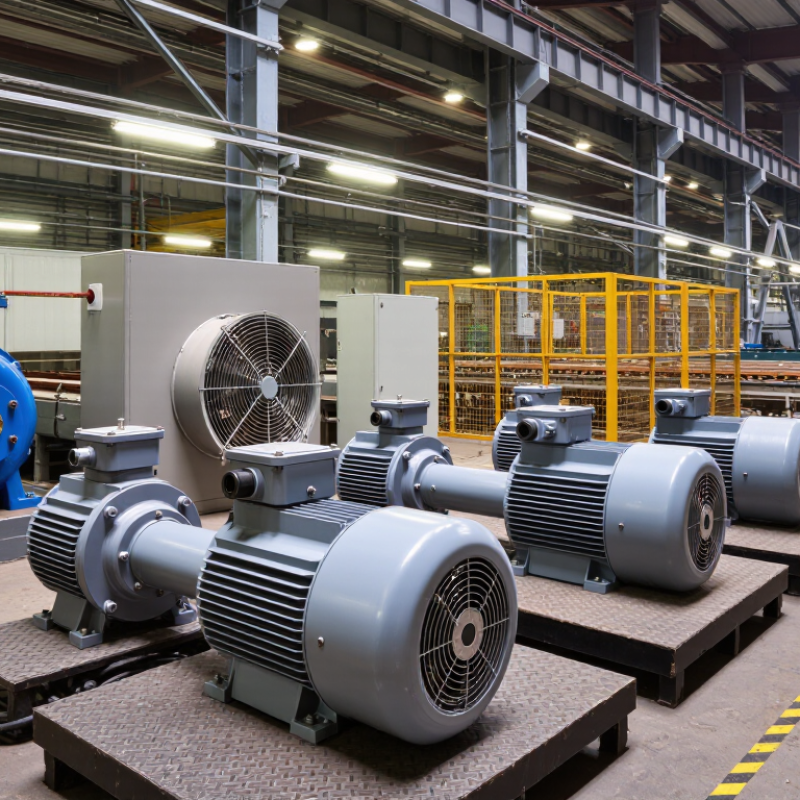
Box-design Ex motors place the terminal box above or beside the frame. This arrangement can simplify cable routing in cramped process areas. However, “box design” is not an explosion-protection method. The motor still needs a suitable Ex marking under IEC 60079 requirements.
IEC 60079-10-1 classifies gas areas as Zone 0, Zone 1, or Zone 2. Zone 0 requires continuous or frequent explosive gas exposure. Zone 1 concerns normal operation. Zone 2 covers rare, short-duration releases. Dust areas use Zones 20, 21, and 22 under the related framework. The enclosure and protection concept must match the zone. A larger terminal box does not improve the classification.
Gas groups matter too. IIA covers less demanding gases, while IIB and IIC require stricter ignition control. IEC 60079-20-1 also defines temperature classes. T1 permits a 450°C maximum surface temperature. T6 limits it to 85°C. Always check the hottest external point, not only the nameplate rating.
The numbers expose the stakes. The IEA 4E Electric Motor Systems Annex reports that motor systems consume roughly half of global electricity. Even small efficiency losses can create measurable operating costs. The U.S. Department of Energy also identifies motor systems as major industrial electricity users.
Yet efficiency alone is not enough. A motor can meet a high efficiency class and still be unsuitable for a Zone 1, IIC, T4 installation. Field experience shows that cable glands, covers, and cooling conditions are often overlooked. The neat specification sheet is not the whole answer.
What Are the Top Box Design Ex Motors?
For Ex motors, the enclosure must control more than dust and water. It must also limit surface temperature and protect internal components in hazardous areas. IP55 enclosures resist limited dust entry and water jets from several directions. They suit cleaner indoor locations, covered equipment rooms, and controlled process areas. However, dust may still accumulate inside over time.
IP66 provides a dust-tight enclosure with stronger water-jet resistance. This rating is more suitable for outdoor installations, washdown zones, and dusty production spaces. Still, IP66 does not automatically mean better thermal performance. A sealed box can trap heat around the windings, bearings, and terminal chamber. Engineers should check ambient temperature, load cycles, cooling fins, and airflow around the motor.
A practical inspection should examine gasket condition, cable entries, drain arrangements, and terminal-box covers. Small gaps often defeat a strong enclosure rating. One overlooked detail matters. Condensation can form after a cool night, even when rain cannot enter. I have seen specifications focus heavily on IP66 while ignoring heat dissipation and maintenance access. That approach needs reconsideration. The correct Ex motor design matches the site’s dust, moisture, temperature, cleaning method, and certified protection requirements. Higher protection is useful, but it is not always the most efficient choice.
The first IP digit indicates protection against solid particles, while the second indicates protection against water. IP55 provides dust protection and water-jet protection; IP56 adds protection against powerful water jets. IP65 is dust-tight and protected against water jets, while IP66 is dust-tight and protected against powerful water jets. IP ratings do not define thermal performance, so motor enclosure temperature also depends on enclosure materials, cooling design, ambient temperature, and heat dissipation.
What Are the Top Box Design Ex Motors?
Box design Ex motors are selected by more than enclosure shape. Their real value appears when efficiency, hazardous-area certification, cooling, and maintenance requirements align. Across 0.12–1,000 kW, IE3 and IE4 ratings create different operating choices.
IE3 motors usually offer broad availability and predictable replacement options. They can suit pumps, fans, compressors, and conveyors with steady duty cycles. IE4 motors reduce electrical losses further, especially at higher annual running hours. However, the savings depend on load profile, speed control, ambient temperature, and motor size. A lightly loaded 0.12 kW motor may not recover its higher purchase cost quickly. A heavily used 500 kW motor can show a clearer financial benefit.
Small ratings often face limited IE4 availability in Ex configurations. Certification, shaft design, thermal protection, and cable entries must remain compatible with the installation. At the upper end, from 250 to 1,000 kW, efficiency testing becomes more significant because small percentage losses represent substantial energy. Site measurements matter. A nameplate alone cannot reveal actual performance.
Do not overlook partial-load behavior. It is often missed. Engineers should compare annual energy use, not only IE classes. They should also verify the applicable hazardous-area standard and temperature class. In practice, the “best” box design Ex motor may be IE3 when supply limits, maintenance skills, or certification scope make IE4 impractical. That choice deserves documented reasoning, not a quick efficiency claim.
| Rated Output Range | Common Pole Options at 50 Hz | Approximate Synchronous Speed | IE3 Efficiency Position | IE4 Efficiency Position | Typical Ex Motor Configuration | Common Industrial Applications | Important Selection Factors |
|---|---|---|---|---|---|---|---|
| 0.12–0.75 kW | 2, 4, or 6 poles | 3,000 / 1,500 / 1,000 rpm | IE3 available Efficiency is strongly affected by the small motor frame size, pole count, and supply frequency. | IE4 available in selected designs Availability can be more limited for certified hazardous-area versions than for standard motors. | Ex db Ex eb Flameproof and increased-safety versions may use different construction details. | Small pumps, fans, conveyors, dosing equipment, and local machinery in hazardous areas. | Confirm starting torque, locked-rotor current, cable entry, terminal-box size, ambient temperature, and minimum inverter frequency. |
| 0.75–7.5 kW | 2, 4, or 6 poles | 3,000 / 1,500 / 1,000 rpm | IE3 widely used A common efficiency level for industrial Ex motor packages and regulated installations. | IE4 increasingly specified Provides lower running losses where operating hours and load factor justify the higher purchase cost. | Ex db Ex eb The selected protection type must match the gas or dust hazard classification. | Process pumps, ventilation fans, compressors, mixers, material-handling systems, and small machine tools. | Check hazardous-area zone, gas or dust group, temperature class, duty cycle, enclosure rating, and thermal overload protection. |
| 7.5–75 kW | 2, 4, 6, or 8 poles | 3,000 / 1,500 / 1,000 / 750 rpm | IE3 established Usually offers a strong balance between purchase cost, availability, and lifecycle energy performance. | IE4 preferred for long operating hours Particularly attractive for continuously running pumps, fans, and compressors. | Ex db Ex eb Ex ec Certification and construction depend on the intended zone and equipment protection level. | Oil and gas pumps, chemical-process equipment, compressors, cooling-water systems, and large fans. | Evaluate annual operating hours, variable-load operation, direct-on-line or soft-start requirements, and the compatibility of the motor with a variable-frequency drive. |
| 75–375 kW | 2, 4, 6, or 8 poles | 3,000 / 1,500 / 1,000 / 750 rpm | IE3 widely adopted Offers reduced losses compared with lower efficiency classes while retaining broad application coverage. | IE4 suitable for high-utilization assets The energy benefit is most significant when the motor operates near its rated load for many hours per year. | Ex db Ex eb Larger frames may require careful thermal, mechanical, and cable-entry verification. | Large centrifugal pumps, process compressors, induced-draft fans, cooling towers, and bulk-material systems. | Verify shaft loading, bearing arrangement, starting method, short-circuit withstand, vibration limits, and the complete motor-drive thermal model. |
| 375–1,000 kW | 2, 4, 6, or 8 poles | 3,000 / 1,500 / 1,000 / 750 rpm | IE3 commonly specified A practical choice where certified availability, starting performance, and capital cost are major priorities. | IE4 project-dependent Confirm that the required Ex protection concept, rating, cooling method, and certification are available together. | Ex db Ex eb High-power hazardous-area motors require project-specific mechanical, thermal, and certification review. | Main process pumps, large compressors, pipeline equipment, cooling-water drives, and major ventilation systems. | Assess grid impact, starting current, driven-equipment inertia, torsional behavior, foundation loads, cooling arrangement, and maintenance access. |
Matching a 2–8 pole Ex motor to the application begins with speed, torque, and S1 duty.
These speeds suit different loads. Pumps often favor 2- or 4-pole designs, while conveyors and mixers may need the stronger starting torque of 6- or 8-pole motors.
IEC 60034-1 defines S1 continuous duty as operation at a constant load until thermal equilibrium.
That detail matters. A motor rated for short duty may overheat during a full-shift process.
The IEA reports that electric motor systems consume nearly half of global electricity, making correct selection an important efficiency decision. The U.S. Department of Energy also identifies industrial motor systems as a major share of plant electricity use. Small efficiency losses become expensive over thousands of operating hours.
IEC 60079 requirements cover enclosure protection, temperature limits, and hazardous-area suitability. Match the motor’s temperature class with the process atmosphere, not only the shaft power.
A lower-speed motor can reduce gearbox stress, but its larger frame may increase installation cost.
I have seen selections made from horsepower alone. That approach misses acceleration, ambient temperature, starts per hour, and actual load variation.
Even experienced engineers should recheck the duty calculation before approving the enclosure and pole count.
When selecting box-design Ex motors, certification must match the installation, not merely the motor frame. ATEX certification supports equipment use in defined explosive atmospheres within the applicable European framework. IECEx certification provides an internationally recognized conformity route. Neither certificate is universal approval.
Check the gas or dust group, protection level, temperature class, ambient range, and enclosure type. These details affect whether a motor remains suitable at 50 Hz or 60 Hz.
Frequency changes can alter speed, cooling, current, torque, and surface temperature. Ask for test data covering the intended voltage and frequency combination.
A nameplate showing 50/60 Hz is useful, but it is not enough evidence. Review the certificate number, issue status, marking, permitted duty, and installation instructions.
Inspect the terminal box, cable entries, blanking elements, seals, earthing point, and bolt condition. Small gaps matter. They can weaken protection.
Confirm that glands and accessories carry compatible Ex approval. Practical audits often reveal complete paperwork with one accessory still unverified. That mistake is easy to miss.
Have a competent engineer compare every item with the hazardous-area dossier and current local requirements. Record ambient temperature, inverter use, overload protection, and maintenance intervals.
If a converter supplies the motor, verify its certification conditions separately. This step is often overlooked.