Industrial Pump Repair Canada - Pump and Seal Repair and Replacement Services
ISO 9001 Certified

Industrial Pump Repair Canada - Pump and Seal Repair and Replacement Services
ISO 9001 Certified
Machine Guarding Doors are not merely panels between people and moving equipment. They shape how operators load parts, clear jams, and access tools during a shift. A door that binds, blocks visibility, or takes too long to open may invite workarounds. Small details matter.
OSHA’s FY2023 Top 10 Most Frequently Cited Standards report included machine guarding, under 29 CFR 1910.212, among its frequently cited standards. These citations are enforcement data, not a measure of injury rates. Still, they show why guarding deserves careful attention. Safety researcher James Reason wrote, “We cannot change the human condition, but we can change the conditions under which humans work” (Managing the Risks of Organizational Accidents, 1997). That principle applies to door design: safe access should fit the real task, not just the drawing.
Choosing a door means checking more than its frame. Consider the machine’s stopping time, opening size, visibility, access frequency, and how the door interacts with interlocks. Then look at the details people feel: a handle that works with gloves, hinges that resist sagging, and a latch that closes reliably. No single design suits every cell. A door that works beside a slow conveyor may be unsuitable near a fast-moving press. The following seven tips offer a practical starting point. Verify each choice against the machine’s risk assessment and applicable safety requirements. And revisit it after installation. Real use can expose what the design missed.
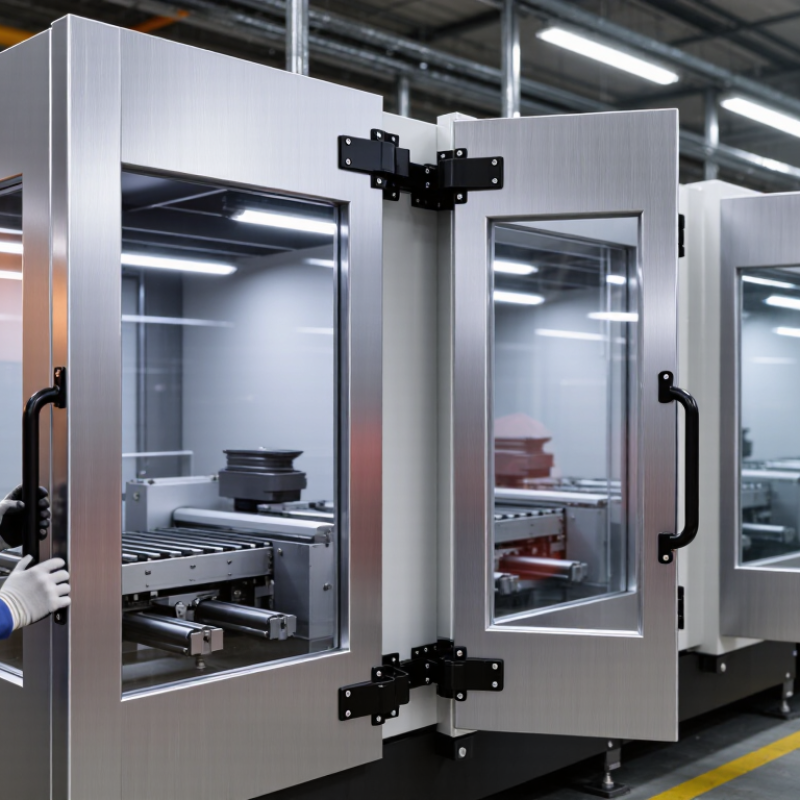
Choosing a machine guarding door starts with understanding what the machine can do and how people work around it. Observe a full production cycle, including loading, unloading, setup, and cleaning. Look for rotating parts, pinch points, hot surfaces, flying chips, and areas where a hand might reach the hazard. Start with the task. A door that blocks access during normal operation may still leave a risky opening during maintenance.
Tip: Watch operators perform routine tasks, then measure the parts and tools they need to move through the opening. Check the required reach, opening width, and door swing. A large panel can be awkward in a narrow aisle; a small one may encourage reaching around it. These practical details are easy to miss on a drawing.
Consider how often the door will be opened and whether operators need to see the process through it. Where a door is interlocked, confirm that the arrangement suits the machine’s stopping behavior and have the design reviewed by a qualified safety professional. Test the real workflow. A layout can look sensible on paper and still frustrate operators, so revise it when observed use reveals a problem.
A hinged guarding door suits frequent access, but its swing can block an aisle or nearby controls. A sliding door avoids that arc and works well beside compact cells. Lift-up doors keep floor space clear, though their weight and overhead clearance need attention. The right choice depends on the task: tool changes, cleaning, or routine inspection each creates a different access pattern. Small detail, big difference.
The operating mechanism matters just as much. An interlocked door signals the machine to stop when opened; guard locking keeps it shut until hazardous motion ends. For equipment with long coast-down times, that delay is critical. OSHA’s FY2023 Top 10 cited standards report recorded 1,644 machine-guarding citations, a reminder that guarding remains a practical safety concern. A door that is awkward to use may invite workarounds. That is not a design detail to shrug off. Test the door with gloves on, check whether chips collect in the track, and watch how operators actually reach the work area. No type is perfect. A site trial often exposes what drawings miss.
7 Tips for Choosing Machine Guarding Doors
Tip 1: Test the interlock with the machine stopped, then verify that opening the door prevents hazardous motion. Tip 2: Check that the switch resists misalignment and cannot be easily bypassed. OSHA’s FY2023 Top 10 report listed machine guarding among its most-cited standards, with 1,356 citations. That is a useful reminder: small hardware details matter.
Tip 3: Look through the door from the operator’s usual position. Can they see the tool, workpiece, and any hazard zone without leaning around a frame? Clear panels help, but glare, coolant, and metal dust can quickly reduce visibility. Tip 4: Choose a panel that suits the actual cleaning routine and environment. A clear view today is not enough.
Tip 5: Confirm emergency access from both sides where the layout requires it. Tip 6: Make the release easy to find and operate under stress, without placing hands near moving parts. Tip 7: Test access during a realistic shutdown drill. OSHA’s machine-guarding guidance emphasizes guarding points of operation and other hazardous areas; door checks should support that protection, not replace it. A latch may feel secure during installation, yet loosen after repeated slamming. Recheck it.
| # | Selection tip | What to check | How to verify |
|---|---|---|---|
| 1 | Match the door to the hazard assessment | Consider the machine’s hazardous motions, access points, work tasks, and the possibility of reaching around, over, or through the guard. | Review the risk assessment and confirm that the door and surrounding guard prevent access to hazards during operation. |
| 2 | Check the safety interlock | Opening the door should initiate the safety function specified for the machine. The interlock should be suitable for the risk and resistant to foreseeable tampering or misalignment. | Test the safety function under controlled conditions. Confirm that the machine cannot run with the door open and that closing the door alone does not cause an unexpected restart. |
| 3 | Assess stopping time and guard locking | If a person could reach a hazard before it stops, a suitable guard-locking function may be needed. Selection depends on measured stopping time, access time, and the machine’s risk assessment. | Have a qualified person assess stopping time and verify that the door cannot be opened while hazardous motion remains accessible, where guard locking is required. |
| 4 | Choose visibility suited to the task | A viewing panel or mesh may help operators observe the process, but it must retain adequate strength and provide the required protection from impact, ejected material, heat, or other identified hazards. | Check sightlines, lighting, cleaning needs, and the panel’s suitability for the hazard. Do not replace protective material with a viewing panel unless the guard’s protective function is maintained. |
| 5 | Plan for emergency access and egress | Where someone could be inside an enclosure, consider the possibility of entrapment and the need for an accessible means of escape or release that does not create a new hazard. | Review enclosure layout and applicable requirements. Confirm any emergency release is identifiable, reachable from the inside where needed, and included in safe operating procedures. |
| 6 | Check door movement and durability | Door size, swing or sliding direction, hinges, latches, handles, and clearances should suit the work area and withstand expected use and environmental conditions. | Confirm the door opens without obstructing walkways or controls, closes reliably, and remains aligned. Include inspection and maintenance in the machine’s safety program. |
| 7 | Keep maintenance and restart controls in view | An interlocked door is not a substitute for energy isolation during servicing. The design should also support safe reset and prevent unexpected startup after access. | Verify that operators can identify the reset procedure and that hazardous energy can be isolated and controlled according to applicable procedures and regulations. |
Selection note: Final door design, interlock functions, and performance requirements should be determined through a machine-specific risk assessment and applicable local regulations and standards.
Tip 1: Match the door material to the hazards and working environment. Check its stated strength against likely impacts, vibration, and repeated opening. In a damp or washdown area, consider corrosion resistance too. A thick-looking panel is not proof of adequate strength. Review technical data, and ask a qualified supplier or engineer when loads are unclear.
Tip 2: Measure the actual opening, not just the dimensions on an old drawing. Record height, width, frame depth, and nearby obstructions. Check that the door provides enough access for routine tasks without creating gaps around the guarded area. Small errors matter. A few millimeters can affect alignment or leave a troublesome pinch point.
Tip 3: Confirm installation compatibility before ordering. Compare hinge positions, latch locations, mounting holes, and the direction of door swing with the existing frame. Check clearance for handles, cables, and adjacent equipment. With machinery safely shut down, a careful fit check can reveal conflicts that a drawing misses. It is tempting to assume standard dimensions will fit; that assumption deserves a second look. Keep the equipment’s guarding requirements and maintenance access in view.
When choosing machine guarding doors, plan for the work that happens after installation. An awkward door may be left unsecured during a rushed adjustment. It happens. Check hinge access, handle clearance, and whether the door can be removed without disturbing nearby equipment. Choose hardware maintenance staff can inspect and replace with ordinary tools, while following the equipment documentation.
Build inspections into existing shift or maintenance routines. Look for loose fasteners, cracked panels, bent frames, worn hinges, and damaged seals. Test interlocks using the site’s approved procedure; never assume a closed door means the safety function works. Record findings, repairs, and dates so recurring wear is visible. Set inspection intervals according to risk, usage, and applicable workplace requirements. A checklist helps, but it can become a box-ticking exercise. Ask operators what feels difficult, then review their feedback after changes. Confirm guards do not block emergency routes or routine service tasks. Document small adjustments too. They are easy to miss later.
Plan maintenance, compliance, and routine safety inspections.
Use this checklist to compare door options and build a site-specific safety plan. A value of 1 means the item should be verified; it is a checklist marker, not a measured performance score. Confirm applicable requirements and inspection procedures for your equipment and workplace.