Industrial Pump Repair Canada - Pump and Seal Repair and Replacement Services
ISO 9001 Certified

Industrial Pump Repair Canada - Pump and Seal Repair and Replacement Services
ISO 9001 Certified
Choosing among China’s top carbide stator manufacturers requires more than comparing prices or polished websites. A carbide stator can look flawless while hiding porosity, poor bonding, or unstable dimensions. In practical service, these defects may appear as vibration, rapid wear, leakage, or unexpected downtime.
Industry data provides useful context. The USGS Mineral Commodity Summaries 2025 identifies China as the leading global tungsten producer. Tungsten is essential for cemented carbide performance. The report also highlights supply-chain and critical-mineral risks. Therefore, buyers should examine material traceability, not only production capacity. The World Bank’s Commodity Markets Outlook also shows that metal prices can fluctuate significantly. A low quotation today may not represent stable long-term value.
A dependable manufacturer should provide carbide grade details, cobalt content, density results, hardness data, and dimensional inspection records. Ask for ISO 9001 certification, batch numbers, and independent test reports when applications are demanding. Check the stator’s inner diameter, outer diameter, concentricity, surface finish, and sealing surfaces. A good factory should explain its tungsten-carbide powder process, sintering controls, grinding equipment, and final inspection method.
Look closely at real evidence.
Request sample parts and cross-sectional analysis. Confirm whether the manufacturer has experience with pumps, mixers, wear assemblies, or other relevant equipment. Industry reports often describe market growth, but they rarely prove one supplier’s manufacturing discipline. That gap matters. A company may claim “top quality” without publishing meaningful process data. This guide may still miss some regional strengths, because supplier performance changes over time. The safest choice combines audited records, verified samples, technical communication, and realistic total-cost analysis.
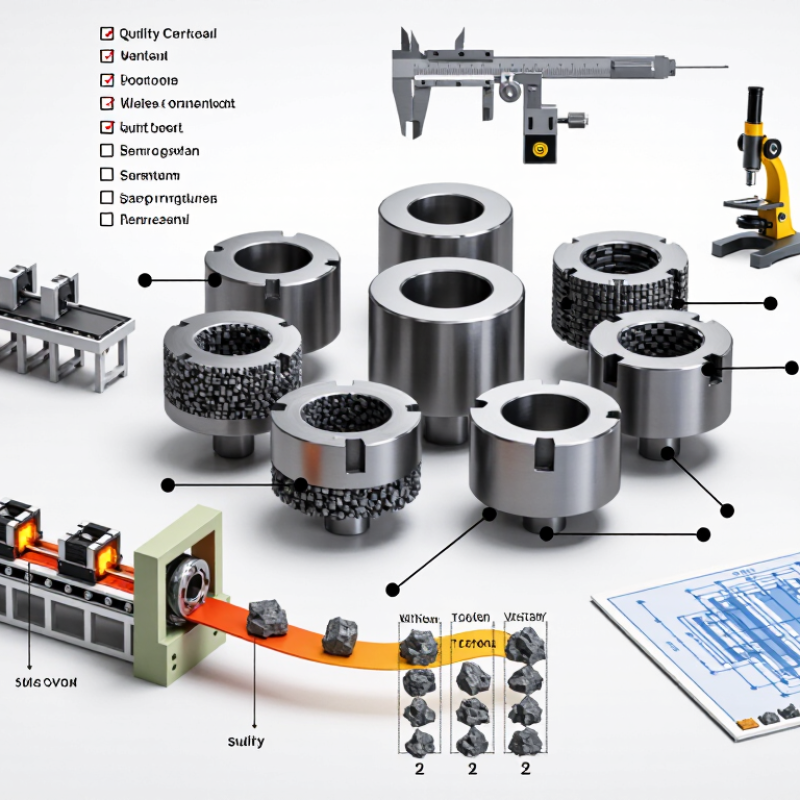
A carbide stator is the stationary part working against a rotating component. It is usually made from tungsten carbide or silicon carbide. The exact meaning can vary. In mechanical seals, it often acts as a hard stationary face. In pumps, similar carbide parts may serve as wear rings or flow-control surfaces.
These components face abrasive particles, pressure changes, and repeated heat cycles. Carbide helps resist scoring and dimensional loss. The U.S. Geological Survey’s Mineral Commodity Summaries 2024 estimated global tungsten mine production at about 81,000 metric tons in 2023. China supplied roughly 67,000 metric tons. This supply concentration makes material traceability important when evaluating Chinese manufacturers.
Carbide stators are used in chemical pumps, oilfield equipment, slurry systems, mixers, and high-speed rotating machinery. However, not every progressive cavity pump stator is carbide. Many use elastomer liners instead. Confusing these parts can cause poor material selection.
Check the carbide grade, binder content, hardness, fracture toughness, and surface finish. Ask for dimensional inspection records and batch-level material certificates. A polished surface alone proves little.
The U.S. Department of Energy reports that motor-driven systems consume about 69% of industrial electricity in the United States. Lower friction may therefore support efficiency, but the real result depends on alignment, lubrication, sealing, and operating speed.
Do not choose by price only. Request application test data. That step is often overlooked.
China’s top carbide stator manufacturers are defined by process control, not attractive catalogs. A reliable supplier should disclose carbide grade, cobalt content, grain size, and heat-treatment records. USGS Mineral Commodity Summaries 2024 reported China produced about 67,000 metric tons of tungsten in 2023. That supply strength matters, but it does not guarantee consistent carbide quality. Ask for batch traceability from powder mixing to final grinding.
Dimensional accuracy is another decisive feature. Request inspection data for concentricity, slot geometry, surface roughness, and hardness. Coordinate-measuring machines and calibrated gauges should support these records. ISO 9001 certification helps, yet it is only a management framework. It cannot replace sampling plans or destructive testing. The IEA has repeatedly identified motor systems as major industrial electricity users, so small efficiency losses can become expensive over long operating cycles. A stable stator surface reduces friction, vibration, and premature wear.
Look closely at technical communication. Engineers should explain tolerances clearly and flag design risks before production. Fast replies are not enough. Trial parts, material certificates, and corrective-action reports reveal more. No supplier is perfect. Even a capable factory may struggle with a new geometry or tight delivery window. Buyers should compare pilot results, not promises. An on-site audit can inspect furnace records, grinding rooms, packaging, and rejected parts. That last detail matters. A manufacturer hiding defects may also hide process variation.
Choosing among China’s top carbide stator manufacturers requires more than comparing hardness figures. Tungsten carbide grades differ in grain size, binder content, density, and corrosion resistance. Higher cobalt content can improve toughness, but it may reduce wear resistance. ASTM B276 testing helps verify density and open porosity. Ask for these results, not only a polished product photo.
Precision controls performance. Check concentricity, roundness, surface finish, and dimensional stability after grinding. A stator with a 0.01 mm deviation may create uneven clearance in a high-speed assembly. Request CMM reports and inspection records from each production batch. The International Energy Agency estimates motor-driven systems use about 53% of global electricity. Small efficiency losses can become expensive across continuous operations.
Tips: Compare the carbide grade with your fluid, temperature, speed, and load. Request wear-test hours and failure photographs. Confirm whether measurements occur before or after coating. Do not trust hardness alone. Durability also depends on brazing, edge design, thermal cycling, and installation accuracy. Suppliers should explain their test method and sample size. Some specifications still look impressive but lack operating evidence. That is worth questioning. A practical trial using your actual medium often reveals more than a generic laboratory certificate.
When comparing China’s top carbide stator manufacturers, buyers should verify quality certifications before discussing price. ISO 9001 is a useful starting point for checking documented quality procedures, inspection controls, and corrective actions. However, a certificate alone does not prove consistent carbide performance. Confirm the certificate’s scope, factory address, registration number, and expiration date through the issuing certification body.
Material control matters greatly. Ask for carbide grade records, raw material certificates, dimensional inspection reports, and batch traceability documents. These records should connect the finished stator to its production lot. For automotive applications, IATF 16949 may indicate stronger process discipline. ISO 14001 and ISO 45001 can also show environmental and workplace management practices, but they should not replace product testing. Check whether the certificate covers the actual manufacturing site, not only a sales office.
Request recent test evidence. Useful details include hardness, density, magnetic properties, surface finish, concentricity, and tolerance results. For export orders, review RoHS or REACH declarations when relevant, and ask how compliance is tested. CE marking is not a universal quality certificate; its meaning depends on the product and applicable requirements. Be cautious with scanned documents that contain unclear dates or mismatched company information. I have seen buyers trust impressive certificates while overlooking weak traceability. That is a costly mistake. An on-site audit or independent pre-shipment inspection may reveal practical gaps that paperwork misses.
China Top Carbide Stator Manufacturers How to Choose?
Price should be compared by specification, not by unit cost. Request the carbide grade, binder percentage, density, hardness, tolerance, coating, tooling, inspection, and delivery terms. The USGS Mineral Commodity Summaries 2024 reported China produced about 67,000 metric tons of tungsten in 2023. This supply strength can support competitive pricing, but raw material exposure still affects quotations. I once compared only prices. That was a mistake. The cheapest offer later added tooling and sorting fees. Ask for a complete cost sheet and a written validity period.
Customization shows technical maturity. Send drawings, mating dimensions, operating temperature, load data, and surface requirements. A capable manufacturer should explain shrinkage, grinding allowance, and achievable tolerances. Request a trial batch, material certificate, dimensional report, and sample approval. ISO’s 2023 Survey recorded more than 1.2 million ISO 9001 certificates worldwide. Certification helps, but it does not prove carbide performance. Check process records, calibration dates, and batch traceability. Real evidence matters more.
Tips: Test one small batch before annual volume. Confirm response times, spare-part policy, replacement rules, and failure analysis. Ask whether engineers can review installation problems remotely. After-sales support should include a named contact and documented corrective actions. The contract should define inspection standards and claim deadlines. A lower price may still be reasonable, but only when quality risks are visible. Some requirements remain uncertain. Record them before approval.